
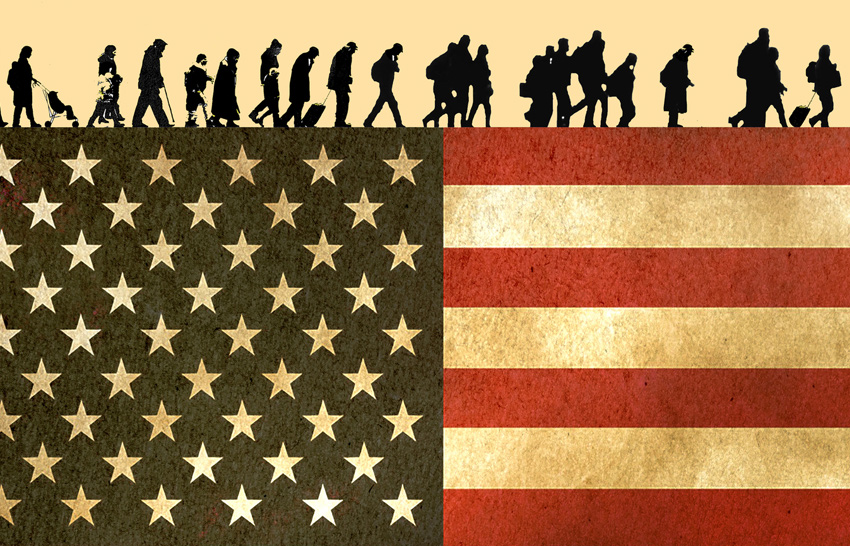
With 53 million foreign-born individuals living in the United States (U.S.) today,1 no other nation in the world has as large an international migrant population as does the U.S.2 Since the passing of the Immigration and Nationality Act in 1965, the U.S. has welcomed millions of people from countries all over the world seeking to re-unify with their families, to earn higher wages and attain higher education, and to receive protection from war and persecution. Regardless of their motivations, one thing that unifies migrant populations is their renewed hope and strive for success as new Americans.
The U.S. is an unquestionably welcoming country to individuals seeking legal pathways to permanent residence, which is something that I as a former refugee from Afghanistan can attest to. However, in recent years, the climate has changed drastically and feels a whole lot different compared to my family’s experience resettling in the U.S. Immigration policies have become less welcoming and more exclusionary, anti-immigrant sentiment has risen sharply, and today’s social and political landscape has become fraught with inflammatory rhetoric around immigration, often dehumanizing refugees from Muslim-majority countries and unauthorized immigrants from Latin American countries. In the case of the Latinx population, negative public sentiment toward unauthorized immigrants, which is fueled by racist ideologies,3 conflate those who are unauthorized with all other Latinx individuals along with their U.S.-born children. Consequently, this group as a whole has become more vulnerable to racial discrimination and poor mental health.4 Moreover, punitive immigration laws targeting this group have been linked to worse self-rated health, mental health and physical disability,5 along with decreased access to and utilization of healthcare services,6-7 with immigration enforcement measures in particular having a “chilling effect” on service access.8
More recently, U.S. policy has also grown increasingly hostile toward asylum seekers and refugees as well—groups that are traditionally protected under humanitarian migration law. Policy changes include suspending refugee admissions, expanding travel bans, and canceling provisions protecting people from deportation.9 My community-based research with Afghan refugees reveals that the government’s stance on asylum applications has stoked fears and anxiety among newly paroled Afghans. People from these communities have shared with me real concerns about being torn apart from their families and returned to the dangerous situations from which they escaped. Others question their place in American society—whether they even belong here—and rightfully so given that some within this community have been detained by immigration enforcement.
Refugees already face immense challenges coping with traumatic losses along with an array of social and economic difficulties endured after resettlement. What the current immigration climate does is it detracts from their well-being, leaving them in a precarious situation where many continue to receive little support and face obstacles in accessing and navigating health and social service systems. What can be done? This is a complex challenge and there is no single solution. But a good starting point may be to connect these vulnerable groups to accessible legal services and to advocate for their rights by getting politically involved (e.g., taking part in demonstrations, writing one’s congressperson, etc.). Health and social services organizations can build trust with immigrant communities by adapting their practices to include assurance of privacy protections and using community health workers to support immigrants and refugees navigate these systems.8 It is also critical for faith-based and other community-based organizations to provide psychosocial support for individuals and their families who feel socially rejected and who live in fear amid this tense immigration climate.
In conclusion, I believe that immigration policy is a social determinant of health, as defined in its broad terms of encompassing the physical, mental, and social aspects of a person’s fundamental right to thrive. The U.S. is, as John F. Kennedy put it, a “nation of immigrants,” and they are integral to our nation’s social fabric, irrespective of legal status. Therefore, it is imperative that academia, health care providers, community leaders, policy makers and other stakeholders advocate for those who have sacrificed so much to call America “home.”
Author Bio
Qais Alemi, PhD, MPH, MBA
Dr. Alemi is a Professor in the Department of Social Work & Social Ecology. He teaches courses in statistics along with qualitative and quantitative research methods. His research interests include investigating the psychosocial needs of populations affected war along with the impact of racism and discrimination on minority groups.
Dr. Alemi is a Professor in the Department of Social Work & Social Ecology. He teaches courses in statistics along with qualitative and quantitative research methods. His research interests include investigating the psychosocial needs of populations affected war along with the impact of racism and discrimination on minority groups.
References:
- Kramer, S., & Passel, J. S. (2025, August 21). Key findings about U.S. immigrants. Pew Research Center. https://www.pewresearch.org/short-reads/2025/08/21/key-findings-about-us-immigrants/
- The Brookings Institution. (n.d.). Our nation of immigrants. Our nation of immigrants
- Lebrón, A. M., Torres, I. R., Kline, N., Lopez, W. D., Young, M. E. D. T., & Novak, N. (2023). Immigration and immigrant policies, health, and health equity in the United States. The Milbank Quarterly, 101(Suppl 1), 119.
- Watkins, L. G., Cobb, C. L., Schwartz, S. J., Duque, M., Montero-Zamora, P., Alpysbekova, A., Romero, S., Ertanir, B., & Martinez, C. R., Jr. (2025). Ethnic discrimination, cultural identification, and well-being among undocumented Hispanic immigrants in the United States: A test of the rejection–identification model. American Journal of Orthopsychiatry, 95(5), 561–573.
- Crookes, Danielle M., Kaitlyn K. Stanhope, and Shakira F. Suglia. "Immigrant-related policies and the health outcomes of Latinx adults in the United States: a systematic review." Epidemiology 33, no. 4 (2022): 593-605.
- Philbin, M. M., Flake, M., Hatzenbuehler, M. L., & Hirsch, J. S. (2018). State-level immigration and immigrant-focused policies as drivers of Latino health disparities in the United States. Social science & medicine, 199, 29-38.
- Vernice, N. A., Pereira, N. M., Wang, A., Demetres, M., & Adams, L. V. (2020). The adverse health effects of punitive immigrant policies in the United States: A systematic review. PloS one, 15(12), e0244054.
- Novak, N. L., Kline, N., LeBrón, A. M. W., Lopez, W., Michelen, M., & Young, M.-E. D. T. (2025, November 6). Mitigating the health impacts of exclusionary immigration policies: An evidence review. Health Affairs.
- American Friends Service Committee. (2026). Trump’s executive orders on immigration explained. https://afsc.org/news/trumps-executive-orders-immigration-explained