

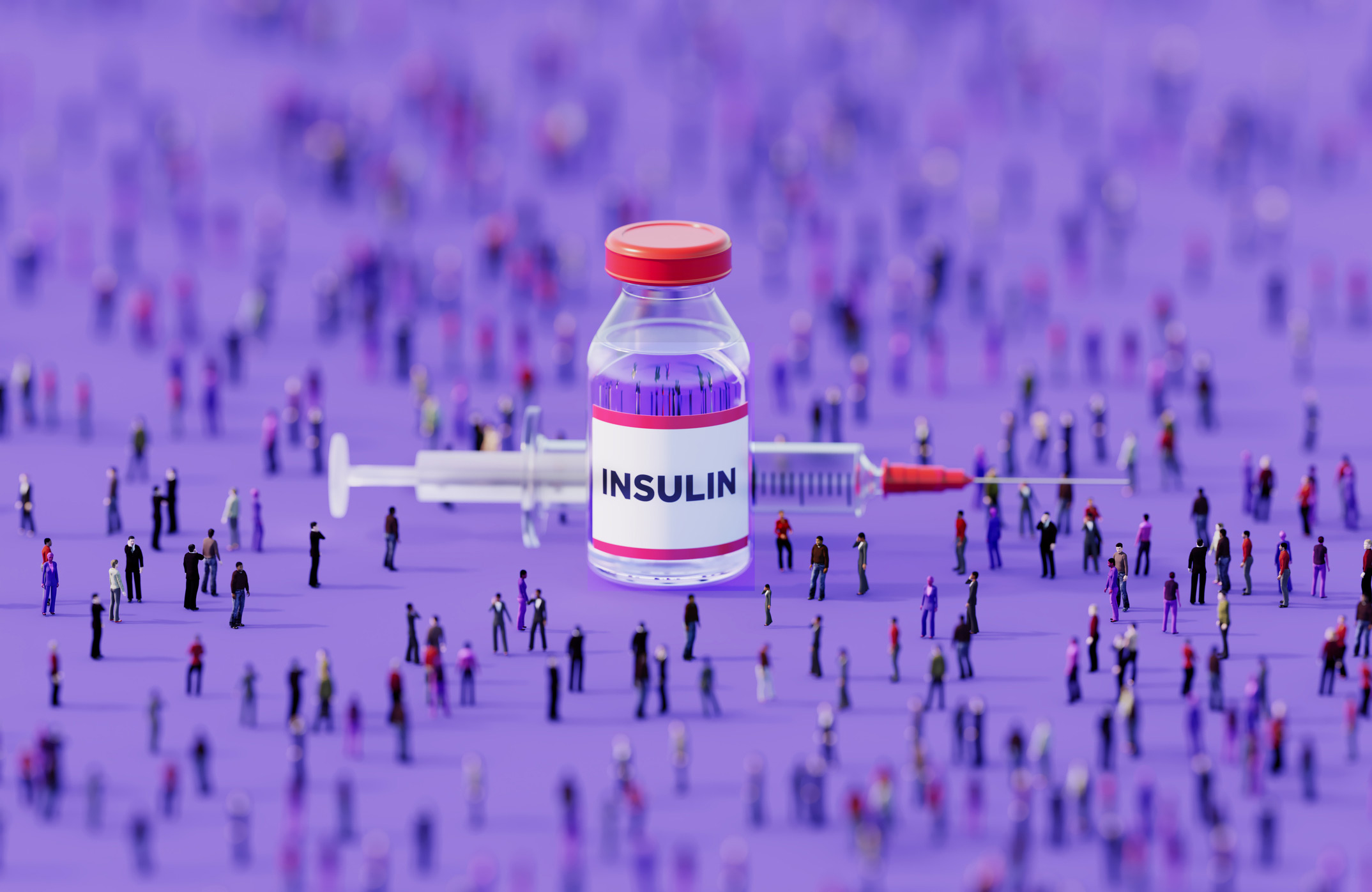
The inflated cost of insulin is one of the most significant and most discussed medication related health policy challenges in the United States. Not long ago in 2022, the discovery of insulin celebrated its 100th anniversary. Initially considered a lifesaving, low-cost treatment for those who suffered from type 1 diabetes, insulin’s cost has ballooned over time, leaving Americans with this chronic condition to face significant financial barriers to obtaining a medication that is essential to their survival. Progress has been made with the passing of the Inflation Reduction Act of 2022, which capped out of pocket cost for Medicare beneficiaries at $35.1, 2 However, patients who are not covered by Medicare continue to carry substantial expenses.
This year, a bipartisan bill titled Improving Needed Safeguards for Users of Lifesaving Insulin Now Act (INSULIN Act) was introduced to Congress to expand the provision to include additional categories of patients and to make structural changes to the insulin market.3 Drawing on principles of justice,4-6 access to insulin is required to preserve “fair equality of opportunity” and, therefore, the Act is morally justified.
Diabetes mellitus consists primarily of two forms. Type 1 diabetes (T1D) is an autoimmune disease in which insulin producing beta cells in the pancreas are destroyed, leaving individuals dependent on life-long insulin injections. Type 2 diabetes (T2D) is characterized by insulin resistance, which can be managed by diet and/or oral medications. Some T2D patients eventually require insulin. The Centers for Disease Control and Prevention (CDC) estimates 40.1 million people in the US have diabetes.7 Of those, about 2.1 million Americans have diagnosed T1D, including roughly 1.8 million adults and 314,000 children/adolescents. Of the 38 million people with other forms of diabetes, which are overwhelmingly Type 2, roughly 8 to 10 million are treated with insulin. While the cost of insulin has dropped for Medicare beneficiaries and for some others due to manufacturer rebates and other cost sharing programs, many of these solutions are sporadic and not easily accessible. Evidence suggests that insulin affordability is still a significant concern. A recent study revealed that 24.1% of patients at Yale Diabetes Center who were prescribed insulin reported cost related insulin rationing.8 Patients with T1D were more likely to ration insulin than patients with T2D. Despite recent policy efforts, one in four people with diabetes still ration their insulin—a number essentially unchanged since 2017.8
The human consequences of insulin affordability are illustrated by the widely cited case of Alec Smith, a 26-year-old young man from Minnesota with T1D.9, 10 After aging out of his mother’s health insurance plan in 2017, Smith faced insulin related expenses of about $1300 per month. Unable to afford his life saving treatment on a restaurant manager’s salary, he rationed his insulin and later died from diabetic ketoacidosis. His death became a national symbol of the insulin affordability crisis and galvanized legislative efforts at both the state and federal levels.
The INSULIN Act of 2026 is a comprehensive legislative proposal that aims to reduce the price of insulin and enhance patient protections regarding insulin-related expenses.3 Key provisions of the Act include commercial market patient protections such as cost sharing limits, elimination of prior authorization requirements or other medical management for selected insulin products (except those necessary for safety and quantity reasons), and broader applicability to certain group and catastrophic plans. The Act also requires pharmacy benefit manager transparency and rebate reform, expediated biosimilar approval, and prompt access to generics. Additionally, provisions include help for the uninsured by establishing state-level pilot programs, providing grants for states to help enroll individuals in manufacturer assistance programs, as well as establishing a national resource center and 24/7 hotline. Importantly, the INSULIN Act is not primarily a subsidy program but emphasizes broader structural changes.
The INSULIN Act is an ambitious proposal, not standing without its critics. Market-oriented traditions emphasize market efficiency, regulatory reform, and increased market competition rather than creating guardrails and structures to reduce costs. The fundamental question is not whether individuals should have access to insulin; they should. But why should society be responsible for providing it? A strong philosophical argument for the Act can be made by drawing on the work of John Rawls and Norman Daniels. In his book A Theory of Justice (1971), Rawls argues that a just society is one that autonomous individuals would choose from behind a hypothetical “veil or ignorance” where they are unaware of their social and economic position, abilities, strength, or fortune.4 They do, however, have a “thin conception of the good” and what they generally value. From this “original position,” people would come to a fair agreement about two principles of justice. First is the liberty principle which guarantees that everyone has an equal set of basic rights and liberties. The second principle holds that inequalities are acceptable in social arrangements if they are arranged to the benefit of the least advantaged. Rawls calls this the “difference principle.” The second—and more relevant principle to this discussion—also establishes that positions and opportunities should be open to all under conditions of “fair equality of opportunity.”
While Rawls provides the normative foundation, Daniels extends Rawls' theory to health and healthcare.5, 6Daniels argues that healthcare holds special moral importance because it protects individuals' “normal opportunity range,” thereby supporting the fair equality of opportunity that Rawls identifies as the second principle of justice. Poor health can limit education, employment, civic participation, family life, and the pursuit of personal goals. Consequently, Daniels argues, access to healthcare is not merely a matter of welfare or compassion; it is necessary for preserving health and “normal functioning,” which are imperative for protecting fair equality of opportunity in a just society.
T1D provides a compelling application of Daniels’ argument. Many illnesses permanently limit opportunities even when treatment is available. T1D is different. With reliable access to insulin and advanced diabetes technology, such as continuous glucose monitoring linked to hybrid closed loop insulin pumps, individuals with T1D can achieve near normal functioning and often excel in demanding professions. In other words, the disease itself does not limit individual and professional advancement when under proper treatment. The history of aviation medicine is a striking example.
For decades, insulin treated diabetes was considered incompatible with piloting planes because of concerns about hypoglycemia (blood sugar levels that are too low). In November 1996, the Federal Aviation Administration (FAA) announced a new policy allowing certain individuals on insulin to obtain special issuance third-class medical certification, beginning on December 23, 1996.11 This change allowed qualified individuals with T1D to fly as student, recreational, and private pilots under carefully monitored medical protocols. The FAA concluded that advances in diabetes treatment justified individualized consideration rather than blanket exclusion. Further expansion of opportunity followed 2019, when the FAA adopted a new protocol permitting insulin treated individuals to apply for first- and second-class medical certification, which are prerequisites to commercial and airline transport flying.12 The FAA explicitly noted that medical improvements since 1996 had made advanced certification possible under stringent safety protocols. This, of course, presumes that the healthcare system is arranged in such a way that aspiring aviators can gain access to medication and advanced technology, something that was out of reach for the young man in the earlier story, Alec Smith.
This development is significant as it highlights the reality that T1D (or T2D requiring insulin) does not in itself limit opportunity and that access truly matters. As individuals become physicians, electricians, business leaders, professional tennis players, and commercial pilots, a healthcare system that is structured to support the unfolding of full human capacity is also one that maximizes social efficiency and economic prosperity. It is important to point out that for individuals treated with insulin, access to health care resources does not create special opportunities or privilege. Employment and training opportunities are still based on aptitude and excellence. However, viewed through the combined lens of Rawls and Daniels, access preserves the normal opportunity range that justice requires a fair society to protect. It is within this philosophical and practical context, the provision of conditions that assure fair equality of opportunity and subsequent enjoyment of professional ambition and growth, that the INSULIN Act of 2026 becomes a matter of justice.
Author bio:
Christiane Schubert, MS, PhD
Dr. Schubert is an Assistant Professor in the Department of Medical Education at the School of Medicine. Her expertise is in research design in the field of human factors and ergonomics. Her research interests include cognitive engineering and decision-making, the development of expertise, and patient/family caregiver engagement in managing chronic conditions.
References:
- Sayed, B. A., Finegold, K., Olsen, T. A., De Lew, N., Sheingold, S., Ashok, K., & Sommers, B. D. (2023, January 24). Insulin affordability and the Inflation Reduction Act: Medicare beneficiary savings by state and demographics. Data Point (ASPE).
- Inflation Reduction Act of 2022, Pub. L. No. 117-169, 136 Stat. 1818 (2022).
- U.S. Congress. (2026). Improving Needed Safeguards for Users of Lifesaving Insulin Now Act of 2026 (S. 4189).
- Rawls, J. (1971). A Theory of Justice. Harvard University Press.
- Daniels, N. (1985). Just health care. Cambridge University Press.
- Daniels, N. (2001). Justice, health, and healthcare. American Journal of Bioethics, 1(2), 2-16.
- CDC National Diabetes Statistics Report. https://www.cdc.gov/diabetes/php/data-research/index.html Retrieved 09.13.2026.
- Khan S., Rahman N., Nally, L. M., Warren, D. B., Branda, M. E., & Lipska, K. J. (2025). Insulin Rationing Persists Despite Policy Changes: Repeated Cross-Sectional Studies, 2017 vs 2024. Journal of General Internal Medicine, 05 November. DOI: 10.1007/s11606-025-09886-9.
- Callaghan, P. (2019, January 23). How the death of Alec Smith pushed Minnesota lawmakers to address the rising cost of insulin. MinnPost. https://www.minnpost.com/state-government/2019/01/how-the-death-of-alec-smith-pushed-minnesota-lawmakers-to-address-the-rising-cost-of-insulin/ Retrieved 09.13.2026.
- Minnesota Attorney General (2021, March 15). “No one should have to choose between affording their lives and affording to live”: AG Ellison, Governor Walz celebrate dismissal of challenge to Alec Smith Insulin Act. https://www.ag.state.mn.us/Office/Communications/2021/03/15_InsulinAffordabilityAct.asp Retrieved 09.13.2026.
- Federal Aviation Administration. (1996). Special issuance of third-class airman medical certificates to insulin-treated diabetic airman applicants. Federal Register, 61(226), 59282-59289.
- Federal Aviation Administration. (2019). Special-issuance medical certification: Diabetes protocol for applicants seeking to exercise airline transport, commercial, or private pilot privileges. Federal Register, 84(216), 60137-60142.