

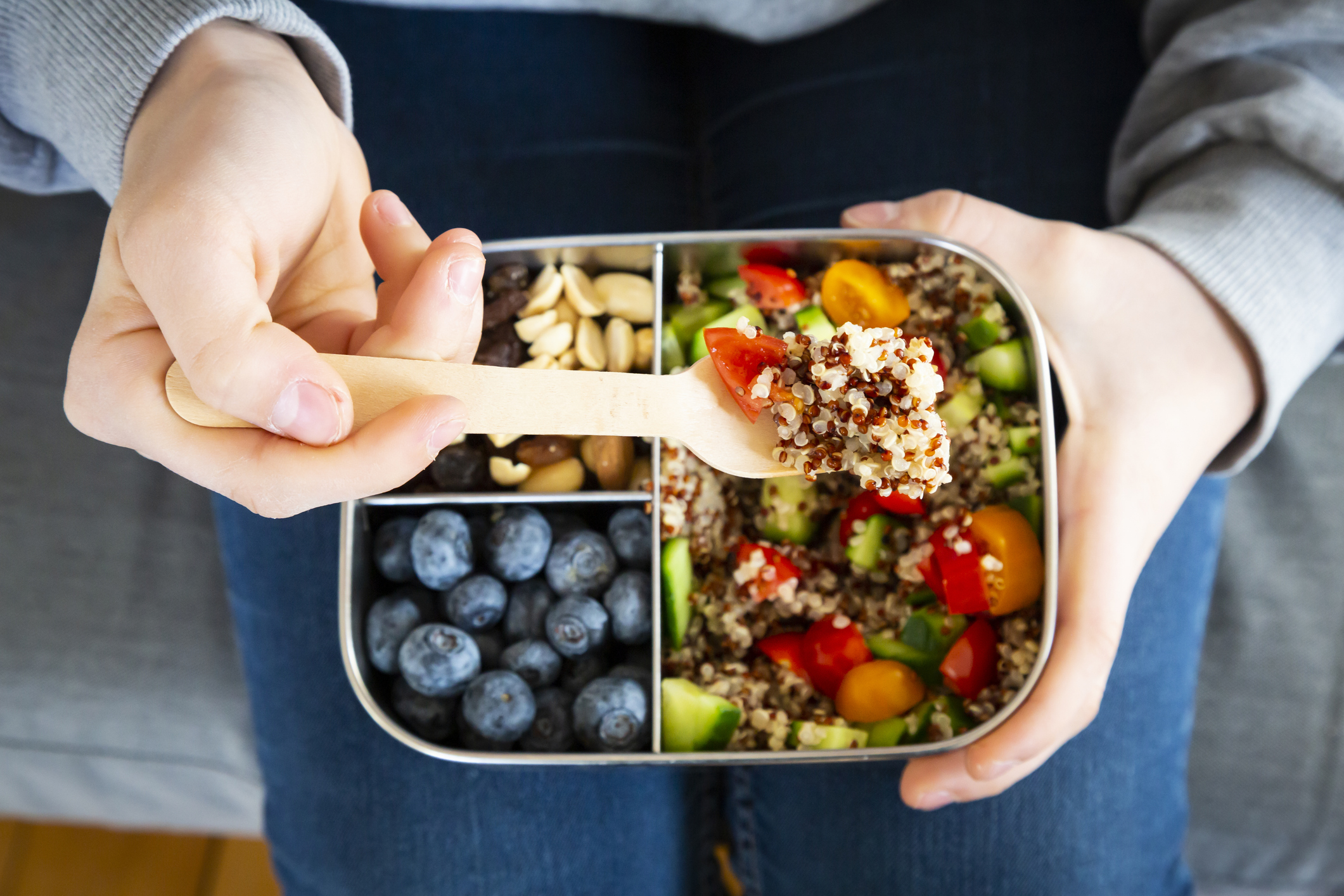
We hear it all the time: If you want to lose weight, eat less and move more. For people who have been struggling to do this for months or even years, that advice can be frustrating to hear. The truth is, the old adage “calories in versus calories out” is technically correct, but it does not tell the whole story. The types of foods (and drinks) we put in our bodies can make it easier or harder to stay within a given calorie range. One way in which this occurs is called the thermic effect of food, or the way our body uses energy in order to digest and absorb nutrients from our food. Foods that are higher in protein and fiber require more calories to be burned in the process of digestion.1 This can make a substantial difference in the calories out part of the equation. For context, up to 30% of the calories from protein can be expended during digestion!2
In addition, foods higher in protein and fiber also increase feelings of fullness much more than more processed foods, making it much easier to refrain from snacking later on. Generally, the less processing a food has undergone, the more nutrients and fiber it retains. Many people believe that fruit juices are healthy because they have “natural sugar.” In actuality, the original source of the sugar is irrelevant when it comes to how the body processes it. What matters is the packaging the sugar comes with, namely the presence or absence of fiber. Fruit juices have been stripped of the fiber from the original fruit, which leads to less fullness and a faster blood sugar spike when we drink them. Whole fruit, on the other hand, contains fiber which slows the digestion of sugar leading to stable energy levels and more fullness. Research has actually linked consumption of whole fruit with decreased risk for diabetes.3 On the other hand, daily intake of fruit juice has been associated in some studies with an increased risk for developing type II diabetes.4
The same principle applies to sources of dietary fat. Refined fats, such as butter and oils, are much easier to overeat than whole food fat sources such as avocados, nuts, and seeds (all of which also contain fiber). Just one tablespoon of oil contains about 120 calories. You could eat half of an avocado for roughly the same number of calories, but you will also be getting many more nutrients, and the fiber will make you feel much fuller.
How can we help reduce the consumption of processed foods? The first step is to define what foods are the most heavily processed and are most concerning for causing disease. The US Food and Drug Administration (FDA) and the United States Department of Agriculture (USDA) are actively working towards establishing a federally recognized definition for ultra-processed foods (UPFs). California is at the national forefront of these efforts with the “Real Food, Healthy Kids Act” (AB 1264) signed in October 2025.5,6 This legislation established a definition for ultra-processed foods and requires a phased ban of these foods from school lunches. The law targets foods with harmful additives, as well as foods with large amounts of saturated fat, sodium and added sugars.6
In summary, it is technically true that losing weight is dependent on the number of calories consumed versus the number of calories burned. However, from a practical standpoint, the nutritional quality of foods consumed has a big influence on how easy or difficult it is to keep your caloric intake under control. So, the next time you are at the grocery store, skip the Fig Newtons and buy some fresh figs (they’re delicious!). Instead of buying orange juice, buy a bag of oranges. You may find yourself surprised by how much you enjoy eating an orange with your eggs in the morning instead of drinking a glass of OJ!
Author bio:
Adam Shafik, DDS
Dr. Shafik is an orofacial pain specialist. He serves as an Assistant Professor in the Oral and Maxillofacial Surgery Department at the School of Dentistry. His research interests include the impact of nutrition on mental and physical wellbeing with an emphasis on the dietary factors involved in the modulation of chronic pain.
References
- Theodorakis N, Nikolaou M. The Human Energy Balance: Uncovering the Hidden Variables of Obesity. Diseases. 2025 Feb 13;13(2):55. doi: 10.3390/diseases13020055. Erratum in: Diseases. 2025 Apr 03;13(4):108. doi: 10.3390/diseases13040108. PMID: 39997062; PMCID: PMC11854607.
- van Baak MA. Meal-induced activation of the sympathetic nervous system and its cardiovascular and thermogenic effects in man. Physiol Behav. 2008 May 23;94(2):178-86. doi: 10.1016/j.physbeh.2007.12.020. Epub 2008 Jan 2. PMID: 18281067.
- Li L, Yang HY, Ma Y, Liang XH, Xu M, Zhang J, Huang ZX, Meng LH, Zhou J, Xian J, Suo YJ, Huang S, Cai JW, Meng BH, Zhao ZY, Lu JL, Xu Y, Wang TG, Li M, Chen YH, Wang WQ, Bi YF, Ning G, Shen FX, Hu RY, Chen G, Chen L, Chen LL, Deng HC, Gao ZN, Huo YN, Li Q, Liu C, Mu YM, Qin GJ, Shi LX, Su Q, Wan Q, Wang GX, Wang SY, Wang YM, Wu SL, Xu YP, Yan L, Yang T, Ye Z, Yu XF, Zhang YF, Zhao JJ, Zeng TS, Tang XL, Qin YF, Luo ZJ; 4C Study Group. Whole fresh fruit intake and risk of incident diabetes in different glycemic stages: a nationwide prospective cohort investigation. Eur J Nutr. 2023 Mar;62(2):771-782. doi: 10.1007/s00394-022-02998-6. Epub 2022 Oct 19. PMID: 36261730; PMCID: PMC9941276.
- Bazzano LA, Li TY, Joshipura KJ, Hu FB. Intake of fruit, vegetables, and fruit juices and risk of diabetes in women. Diabetes Care. 2008 Jul;31(7):1311-7. doi: 10.2337/dc08-0080. Epub 2008 Apr 4. PMID: 18390796; PMCID: PMC2453647.
- https://www.gov.ca.gov/2025/10/08/governor-newsom-signs-first-in-the-nation-law-to-ban-ultra-processed-foods-from-school-lunches/
- https://legiscan.com/CA/text/AB1264/id/3137564