

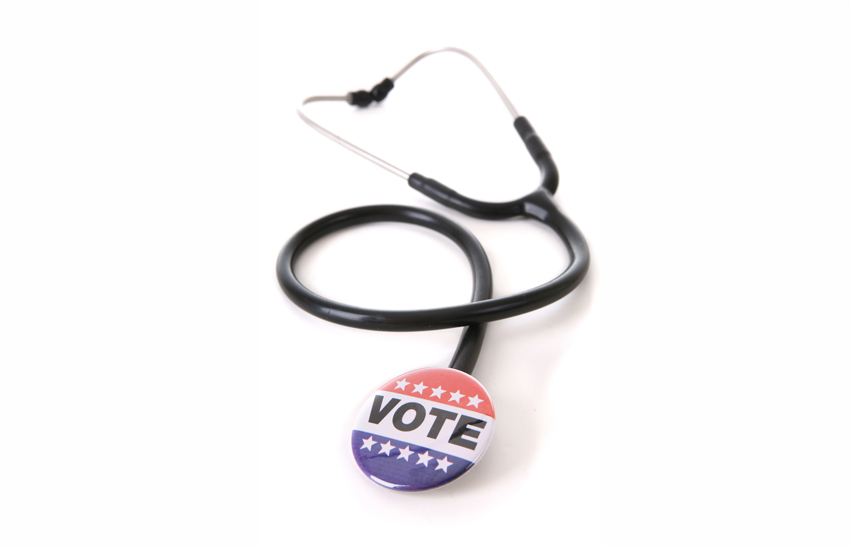
Our country’s midterm election, which is scheduled for Tuesday, November 3, is just around the corner, and voters will have the opportunity to decide which candidates will represent them in government and what should happen to the various propositions on the ballot for their state of residence. Midterm elections are elections that take place halfway between presidential elections, and voter turnouts are generally lower than those of presidential elections as people are more interested in who becomes the President than who becomes their members of Congress.1,2
The United States Congress is made up of the House of Representatives and the Senate. Members of the U.S. House of Representatives serve fixed, two-year terms, and all 435 seats in the House of Representatives are up for election every two years—during both presidential election years and midterm election years.1 In contrast, only one third of the 100 Senate seats are up for election at a time with each Senator serving six-year terms.1 As such, 33 Senate seats are up for election this November along with another two seats that are up for special election: one to fill the last two years of the six-year term that Marco Rubio (R-Fla.), who is now serving as the U.S. Secretary of State, was elected to in 2022 and the other to fill the last two years of the six-year term that Vice President J.D. Vance (R-Ohio) was elected to in 2022.3 Although not as glamorous as the presidential elections, midterm elections are very important as members of the Congress help determine which laws and policies govern our country.
In addition, states such as California will determine their next Governor and state legislators during this November election. There are 36 gubernatorial seats, 31 lieutenant gubernatorial seats, 30 attorney general seats, and 26 secretary of state seats across 43 states up for decision this election.4 As for state legislatures, 88 of the 99 state legislative chambers in the U.S. are holding regular legislative elections this year.5 Candidates for local jurisdictions will also be included in the ballot along with state propositions for voters to decide on key issues.
To encourage people to vote, polling places are generally open from early in the morning to late in the evening. In case some people’s work hours still preclude them from going to the polls, many states require employers to grant employees time off to vote. For example, California’s state law allows employees to take up to two hours of paid time off to go vote.6 As of October 2026, 28 states and the District of Columbia require employers to give employees time off to vote.7 All 50 states also offer the option to vote by mail, but the circumstances under which they allow it differ depending on the state.8,9 Eight states and the District of Columbia automatically send ballots to every registered voter while twenty-eight states allow any voter to request a mail-in ballot without a reason. In contrast, fourteen states require a qualifying excuse before they will send a mail-in ballot.10
No matter the method, participating in election by voting is important for not just civic engagement but also for health. Various studies consistently show that voting and health outcomes are closely linked, with those who vote having better mental and physical health than those who do not.11,12 Also by voting, one helps shape the future of many policies that govern our health, healthcare, and public health. As such, the American Medical Association (AMA) passed a resolution in 2022 declaring voting as a social driver of health and supporting “measures to facilitate safe and equitable access to voting as a harm-reduction strategy.”13
So as November 3 approaches, will you vote to improve your health?
Author bio
Wonha Kim, MD, MPH, CPH, FAAP
Dr. Kim is the Director of the Institute for Health Policy and Leadership. She is also an Assistant Professor of Pediatrics and of Preventive Medicine at the School of Medicine and an Assistant Professor for the School of Public Health. Her research interests include pediatric obesity, social determinants of health, global health and policy approaches to addressing health issues faced by vulnerable populations.
References:
- https://www.usa.gov/midterm-elections
- https://usafacts.org/articles/who-shows-up-to-the-midterms/
- https://ballotpedia.org/United_States_Congress_elections,_2026
- https://ballotpedia.org/State_executive_official_elections,_2026
- https://ballotpedia.org/State_legislative_elections,_2026
- https://elections.cdn.sos.ca.gov/pdfs/tov-english.pdf
- https://ballotpedia.org/Time_off_work_for_voting
- https://www.ncsl.org/elections-and-campaigns/table-18-states-with-all-mail-elections
- https://www.usa.gov/absentee-voting
- https://www.findlaw.com/voting/my-voting-guide/vote-by-mail-states.html
- https://ihpl.llu.edu/sites/ihpl.llu.edu/files/archive/2024-11/November_2024_IB_0.pdf
- https://www.heart.org/en/news/2024/10/14/how-voting-plays-a-role-in-health
- https://policysearch.ama-assn.org/policyfinder/detail/voting?uri=%2FAMADoc%2FHOD.xml-h-440.805.xml